Should the job use a cable machine or hydro jetting?
It depends on what is in the pipe and how far it reaches. A cable machine, sometimes called a snake, is usually enough for a localized clog from hair, paper, or a small root intrusion. The rotating cable punches a channel through the blockage and restores flow, and for a single slow bathroom sink or tub that is all the job needs. The limit of a cable is what it leaves behind. It opens a hole through the middle of a clog, but grease, scale, and sludge stay stuck to the pipe wall, so the line narrows again within weeks. Hydro jetting sends high-pressure water through the line and scours the full interior wall. It is the better call for grease coating a kitchen line, recurring clogs in the same spot, roots that were cut back once and returned, or a line that keeps slowing down after cabling. A jetter needs a reachable cleanout, and it is not right for a pipe that is cracked or collapsing. That is where a camera comes in. A camera inspection shows the pipe's condition before the plumber chooses a method. The plumber decides after seeing the line, and that choice affects the cost of the visit for a home in Kingston, MO.
One practical point is that the choice is not always made in advance. A plumber often starts with a cable, finds out what is actually in the line, and then moves to a jetter if the cable returns with grease or sludge instead of a clean break. For that reason it helps to ask which method is planned and what would make the plumber change course. Jetting also depends on pipe condition, which is another reason a camera sometimes comes first on an older line. Clay and cast iron that are thin, cracked, or shifted can be damaged by high pressure, while newer plastic pipe handles it well. Water use matters too: a jetter sends a lot of water into the line, so the drain has to be open and flowing downstream. After either method, run water for several minutes and watch for slow spots or gurgling that might mean something is still in the way.
What is trenchless sewer repair and when is it an option?
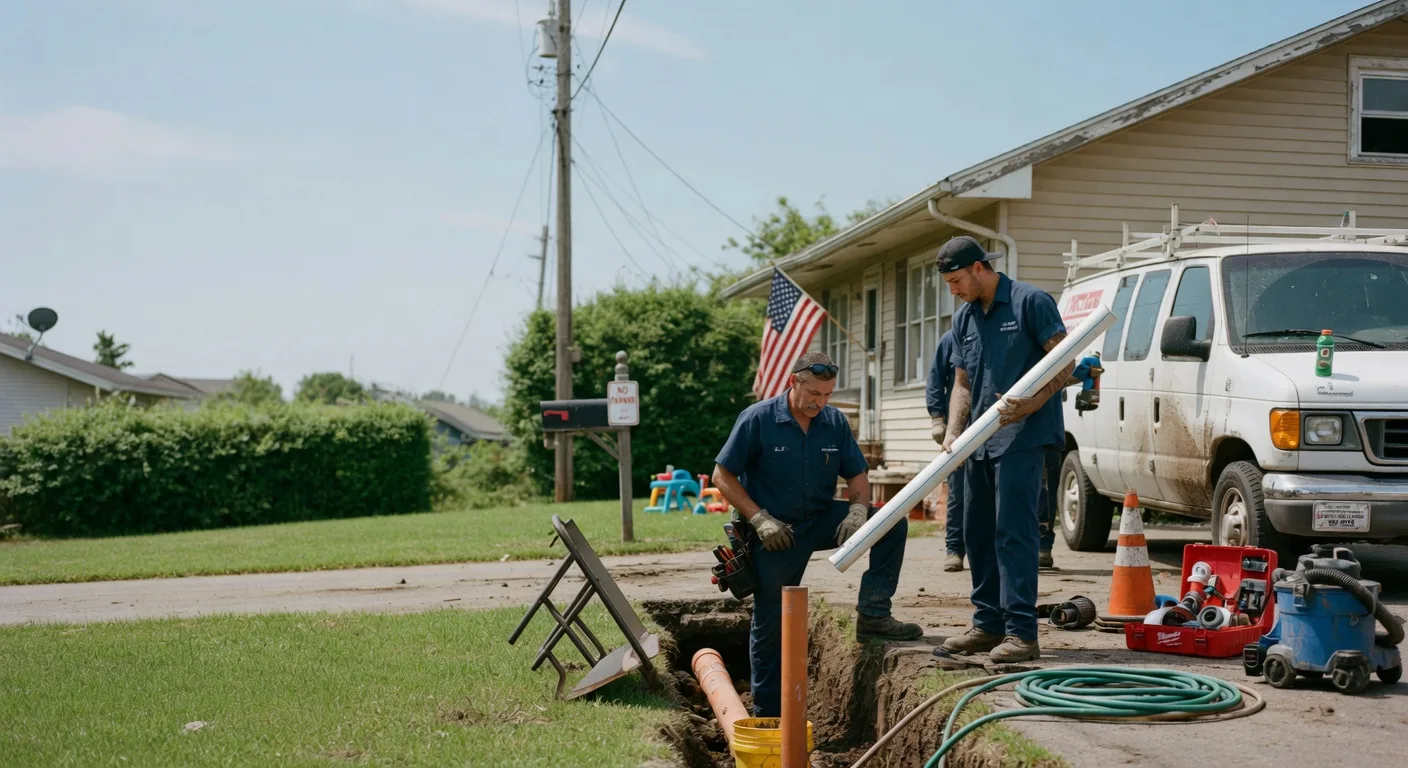
You have been told the sewer line may need replacing, and you want to know if that means digging it all up. Trenchless repair avoids that. The plumber works from one or two small access pits, or from an existing cleanout, and either lines the old pipe from the inside or pulls a new pipe through the old path.
It is an option when the line is cracked, offset at a joint, or split by root intrusion at a clay joint, but still runs as one continuous pipe. Cast iron choked with scale can sometimes be lined too, after the scale is cleared. That usually means hydro jetting first, then a camera inspection to confirm the pipe condition.
It is not an option when the pipe has collapsed, when a bellied line holds water and the slope has to be corrected, or when sections are crushed or missing. A liner follows the old path, so a sag stays a sag. Those jobs need open excavation.
The camera inspection decides it. If the main line clogs again after every Drain Cleaning visit, the pipe may be failing, not just dirty.
Cost depends on how deep and how long the line is, how many access points are needed, the materials used, how much has to be opened up or removed above it, and any permit or code requirement. Expert Plumbers Co is a referral service, not a plumbing contractor. Call (380) 262-9173 and we will refer you to a plumber serving Kingston, MO who can inspect the line.
Before any lining starts, ask the plumber to confirm where every side connection joins the main. Branches such as a second bathroom or a laundry line have to be reopened from the inside once the liner sets, and the camera run afterwards should show each one open. Tell the plumber about earlier backups, the age of the house and any past repairs, because older homes often have clay, cast iron and fiber pipe in the same run, and the liner has to bond to each. The finished pipe is slightly narrower inside, but its surface is smooth, so flow usually improves. Plan around laundry and showers while the liner cures, since the line cannot be used until it has set. Ask for the recording of the finished pipe and keep it with your house papers. It helps if you sell the home, and it shows the next plumber exactly what was installed and where it runs.
Why did the clog come back worse after I used a store-bought drain snake?
You ran a snake from the hardware store, the water moved for a day, and now the sink is worse than before. That is common, and it comes down to the tool.
A thin hand-crank snake often punches a small hole through the middle of a clog. Water trickles through, so it seems fixed. The clog is still there, and it gets packed tighter as new debris catches on it. Sometimes the snake pushes the clog deeper into a bend, where it is harder to reach. A snake also does not scrape the pipe wall, so the grease build-up stays and the clog forms again quickly.
It is the wrong tool for roots, a bellied line holding water, or scale in cast iron. Those need a heavier cable with a cutting head, hydro jetting, or a camera inspection to see what is actually in the pipe.
Safe homeowner check: place a bucket under the trap, remove it and clear it by hand. Do not add chemical cleaners after snaking, because the plumber may then be working in caustic water.
Stop running water and call if the snake stuck or will not come back out, if other drains gurgle or back up, or if you smell sewage. That points past a single fixture to the main line.
Cost depends on access, what is found, and how much has to be opened up. Expert Plumbers Co is a referral service. Call (380) 262-9173 for Drain Cleaning help from a plumber serving Kingston, MO.
After a failed snake attempt, leave the fixture alone and tell the plumber exactly what you did: the type of snake, how far it went in, whether it hung up, and whether you used any chemical cleaner first. That saves time on site and tells them whether the cable is still stuck or the clog was pushed into a bend. Do not keep running the snake in the hope that it will break through. Forcing a thin cable through a trap or a sharp bend can scratch the pipe wall or damage the trap, and in old cast iron it can knock loose scale that adds to the blockage. Also stop using the sink for a few hours if you can, because the extra water tends to carry loose debris deeper. Expect the proper clearing to include a look at the pipe wall afterwards, so you know whether this was a one-off blockage or a pipe that keeps catching debris.
My sink gurgles after it drains and someone mentioned an air admittance valve. What is that, and can it fail?
"My sink gurgles after it drains" is one of the most common things people notice before a drain problem gets worse. Every fixture needs a vent so water leaving the trap does not pull a vacuum. When air cannot get in, it gets dragged through the trap water instead, and that is the gurgle.
An air admittance valve, or AAV, is a small one-way valve fitted on a vent pipe, often under a sink or in an attic. It opens to let air in as water drains, then drops shut so sewer gas stays in the pipe. Many local codes allow them and some do not, so rules vary by area.
Yes, they can fail. The rubber seal wears, dust or debris stops the flap seating, or the valve sticks. A valve that will not open brings back the gurgling and slow draining. One that will not close lets a sewer smell into the cabinet or room.
A blocked vent stack on the roof, a partial clog in the drain, or a bellied line holding water can also cause gurgling. One gurgling fixture usually points to its own trap, branch line or vent. If the tub, toilet and floor drain all gurgle together, or the toilet bubbles when the washer empties, suspect the main line or the main vent.
Safe homeowner check: Run just the gurgling sink and listen, then run another fixture and see if it does the same. Do not pry at vent parts inside walls, and do not pour drain chemicals into a line that is already gurgling.
Stop running water and call now if sewage smell is strong, water comes up in a tub, shower or floor drain when you use another fixture, a toilet bubbles or rises, or any fixture stops draining.
A cable machine is usually enough for a clog in a single branch line, like the pipe behind one sink. If the gurgle returns, or several fixtures are affected, the plumber may want a camera inspection to look for root intrusion at a clay joint, a bellied line, or a failing section. A blocked roof vent is cleared from the roof, not with a drain cable.
Expert Plumbers Co is a referral service. We connect you with an independent local plumber in Kingston, MO. Call (380) 262-9173.
Ask the plumber whether an AAV is permitted where you live, or whether a conventional vent is needed instead. Cost depends on access to the pipe, the parts or materials needed, how much wall or ceiling has to be opened, and any permit or code requirement.
Can I rent a hydro jetter or a big drain machine and do the main line myself?
"Can I just rent a hydro jetter and do the main line myself?" You can rent one at many tool shops, so it is a fair question. The honest answer is that it is a bad bet on a main line, for reasons of both pipe and safety.
A hydro jetter pushes water at very high pressure through a hose with a nozzle that pulls itself down the pipe. In the right hands, on sound pipe, it cleans grease and scale off the pipe wall. In the wrong hands it can break old clay or cast iron, wash out joints, drive water into a cracked pipe, or punch through a thin spot. Root intrusion at a clay joint can hold the nozzle, and a bellied line can trap it.
A large drain machine has its own risk. The spinning cable can whip, snag and twist. It can wrap a hand or arm in a second.
There is a bigger issue. Without a camera, you do not know what you are cutting. A main line that backs up may be roots, a bellied line, a collapsed section or a failed sewer lateral. Clearing the blockage may only open a hole through it, and it returns soon after.
Safe homeowner check: Run one fixture at a time and note which drains slowly. Check if it is one fixture or every drain in the house. Do not pour drain chemicals into a line that is backing up.
Stop running water and call now if sewage is coming up in a tub, shower or floor drain, the toilet bubbles or rises when you run other fixtures, or you smell sewage in the house. Stop using water in the house until the line is cleared.
A cable machine is enough for a simple clog in a branch line. Hydro jetting is for grease and scale on the pipe wall. A camera inspection is the step that tells the plumber what is in the pipe and what tool is safe to use, which is what a rental cannot give you.
Expert Plumbers Co is a referral service. We connect you with an independent local plumber in Kingston, MO. Call (380) 262-9173.
Ask the plumber to show you the camera footage and explain what was found. Ask whether the pipe is sound enough for jetting. Cost depends on access to a cleanout, the parts or materials needed, how much has to be opened up or removed to reach a damaged section, and any permit or code requirement.